
Exploring the Relationship Between Language Prediction and Production
Learn more about age-related language processing differences and the relationship between language prediction and language production. This research was conducted at Penn State University as part of my doctoral dissertation.
*Disclaimer: Despite the use of em dashes in the documents above—these examples are excerpts from my doctoral dissertation and were written in 2021.
Background
-
As people get older, they often experience changes in their language production abilities that can be frustrating. Language production can refer to the act of speaking, or even typing. Some examples of changes older adults (people > 60 years) find difficult include having trouble finding the words they want to use, speaking more slowly, or using more filler words (e.g., uh or um).
-
On the other hand, language comprehension (i.e., our understanding of language input) remains relatively stable across our lives. Interestingly, language prediction, which occurs during language comprehension, also shows declines, just like language production. So what is language prediction? This is a process when people anticipate upcoming information. We all do this when reading books or watching movies, or even when talking to our friends and family. We also can predict upcoming information on a subconscious level based on all the information we've already encountered.
-
Language processing theories suggest that language prediction and language production are related processes, with language prediction using the same brain regions used during language production. While some studies find evidence in support of this relationship, it is not well understood, and how age factors in, even less so.
Methods
-
I conducted a series of four online behavioral studies in 320 younger and older adults to examine the relationship between language prediction and production, and how this relationship might differ with age.
-
Participants completed a series of self-paced reading tasks to examine prediction, language production tasks, and other cognitive tasks to explore possible underlying mechanisms (e.g., memory and processing) of the prediction–production relationship.
-
2 of the 4 studies had participants use their production system. The goal was to determine if giving participants the expectation to use their production system would encourage them to predict upcoming information (See example from one study below).
Reading Only
Reading and Langauge Production to Encourage Prediction
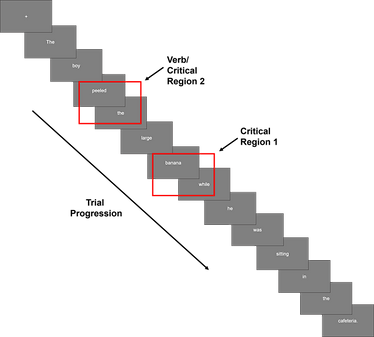

Figure Caption. Participants read the sentences once word at a time and pressed the spacebar. The spacebar presses were used to establish reading times. In the Production example (right), instead of reading the whole sentence, participants were shown a picture and had to type the name of the picture when it appeared. Items that were more predictable based on how the sentences were written were named faster than items that were less predictable. Both examples show predictable sentences. Areas outlined in red are the reading times examined.
Results
-
Overall, results showed age-group differences in language production, but the age-group differences in prediction were less reliable.
-
Additionally, results did not consistently demonstrate evidence of predictive processing occurring during the self-paced tasks.
-
However, during the components of the self-paced tasks explicitly requiring language production, there were significant effects of prediction, as well as an interaction between sentence type and age-group (see figure below).

Figure Caption. While both younger and older adults named items that were more predictable faster than less-predictable items (see figure above for an example of the naming condition), there was a larger difference in the picture naming response times for the 2 predictability conditions in older adults (about 300 milliseconds) compared to the younger adults (about 100 milliseconds).
Conclusion
-
Taken together, this suggests a relationship between language prediction and language production, with some evidence for age-group differences in the relationship.
-
More research needs to be conducted to understand what cognitive factors (e.g., memory and processing) underlie this relationship, as the results from these analyses were not significant.